
How Kettleby Freight retired 14 spreadsheets in a quarter
14
spreadsheet processes retired in one quarter
3 days
to close the month, down from 9
€310k
in carrier overbilling caught in six months
At a glance
Industry
Logistics
Company size
2,400 people
Headquarters
Rotterdam, NL
Team
Finance
Builders and members
5 builders, 160 members
Apps built
14 apps
Built with


The company
Kettleby Freight is a freight forwarder and third-party logistics provider based in Rotterdam. Its 2,400 people move ocean and road freight for about 900 shippers across Europe, from customs clearance to the last warehouse door.
Fourteen files, one owner each
At the end of 2025, Kettleby’s finance operations team ran its month on 14 spreadsheets. Carrier invoices were checked against rate cards by hand. Demurrage disputes lived in a shared workbook with 40 tabs. Freight accruals were rebuilt every month from a Snowflake export, and each file had exactly one person who understood it.
“When someone was on leave, that process stopped,” says Dana Okafor, Finance Operations Lead. “When an auditor asked who changed a rate, we couldn’t say.”
Engineering had a two-quarter backlog, so any request for new tooling would have waited until the summer. The team had tried a form builder the year before, but IT blocked it because nobody could say where the data went.
One app a week, starting with rates
Dana’s team opened the Bench in January and started with the file that hurt most: carrier rate approvals. The first prompt was one paragraph. It asked for a queue of carrier invoices from the transport management system’s Postgres database, a check against the agreed rate card, and a second approver for any variance over €500.
The first working version arrived 12 minutes later. The team spent the rest of the week on edge cases like currency conversion, partial shipments and credit notes. By Friday, Rate Desk was live for 22 people.
The other 13 apps followed at about one a week. Accruals moved to a scheduled Job that reads Snowflake every night and writes a job sheet the controller reviews each morning. Demurrage disputes became a queue, with the supporting documents stored in Amazon S3. Approval requests post to Slack, so approvers don’t have to watch a dashboard.
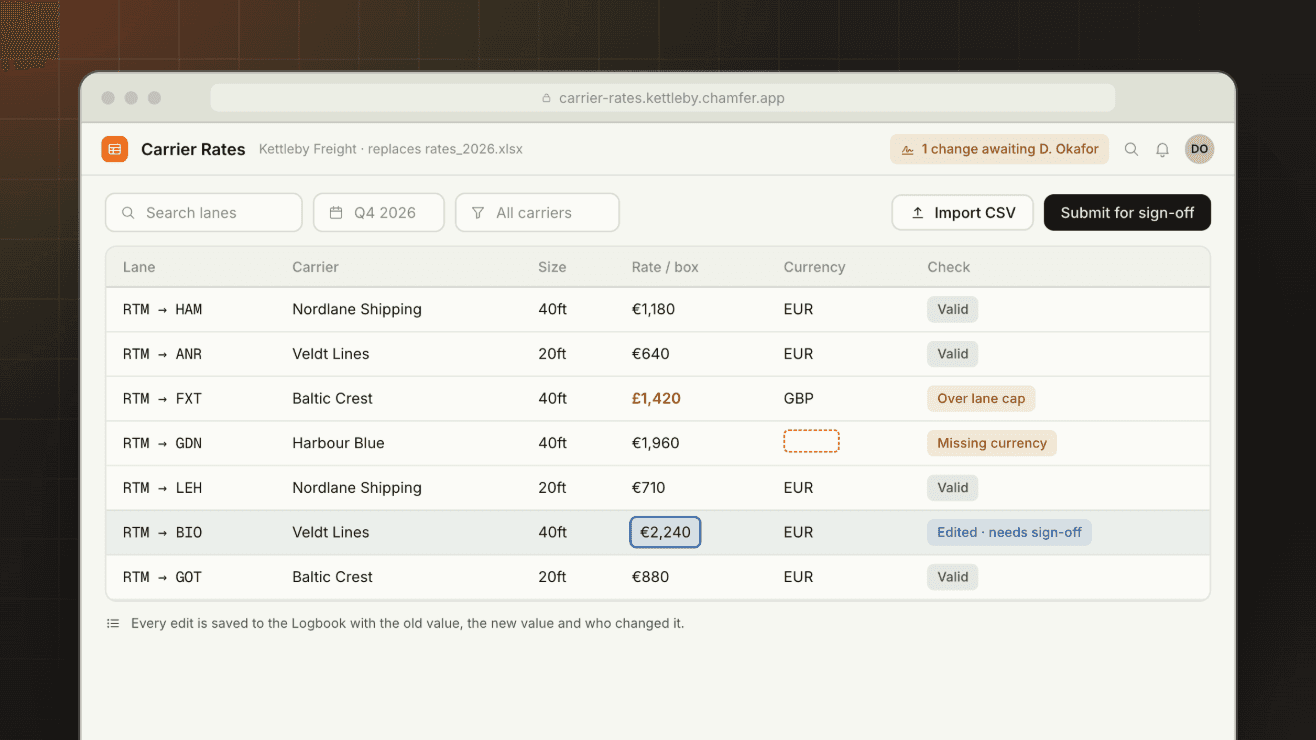
Named approvers from the first release
Kettleby’s IT team set two conditions before rollout. Every app needed a named owner, and nothing could reach production without a Sign-off.
Tolerances covered both. Access follows Kettleby’s existing Microsoft Entra ID groups, so a new analyst gets the right apps on day one and loses them the day they leave. Every release goes through a Sign-off with a diff, and the Logbook records who approved it. One Spec, written as a single sentence, keeps supplier bank details out of every app the team builds.
“IT stopped asking whether finance could be trusted with its own tools,” Dana says. “They can see exactly what we shipped and who approved it.”
What changed
14 spreadsheet processes retired in one quarter
Month-end close down from 9 working days to 3
€310,000 in carrier overbilling caught in the first six months
The team runs 14 apps today, with 5 builders and 160 members. Next on the list is a shared dock schedule for the warehouse team in Venlo, which will reuse the same approvers and access groups.
“We replaced 14 spreadsheet processes in one quarter, and every app had a named approver before it went live.”

Dana Okafor
Finance Operations Lead, Kettleby Freight
Read another story

Halden Mutual cut claims triage from 3 days to 4 hours

Halden's claims team scores and routes every new claim within hours, and IT Risk answers its auditors straight from the Logbook.
Read the story →

Tessaly put 40 agents on a new refund queue in 4 days

Tessaly's support team described a refund queue on Monday and had 40 agents working it behind SSO by Thursday.
Read the story →

Brackwater moved turbine inspections off paper in 9 days

Brackwater's field team took turbine inspections from paper to a mobile app in nine days, running Onsite in its own network.
Read the story →