
Quenby took 17 admin tools off the engineering backlog
1,900
engineering hours returned in year one
17
admin tools moved off the backlog
2 days
to ship an admin change, down from 3 weeks
At a glance
Industry
Fintech
Company size
650 people
Headquarters
Dublin, IE
Team
Engineering
Builders and members
8 builders, 230 members
Apps built
17 apps
Built with


The company
Quenby issues corporate cards and runs B2B payments for 4,000 mid-market companies across Europe. Its 650 people work from Dublin and Amsterdam, and every tool they use is in scope for regulatory audit.
Admin panels on the roadmap
Quenby’s engineering team spent about a fifth of every sprint on internal tools. Finance needed a way to raise a card limit. Customer success wanted a view of upcoming renewals. Risk asked for a screen to freeze a card without filing a ticket. Each request was reasonable, and each one pushed the product roadmap back. The tools built in a hurry also had no audit trail. When the regulator asked who had raised a particular limit, an engineer had to search application logs by hand.
Theo Marchetti, VP Engineering, added it up in early 2025: roughly 1,900 hours a year went to screens that only employees would ever see.
Engineers write the rules, teams build the tools
Instead of building each tool, Theo’s team wrote the rules once. They connected Quenby’s Postgres ledger replica, Stripe and Salesforce to Chamfer, then wrote Specs in plain English: card numbers are always masked, any limit change above $10,000 needs a finance sign-off, and nobody writes to the ledger directly. Writing and reviewing them took one afternoon. The team then tested each rule by prompting for a tool that broke it and confirming the build was blocked.
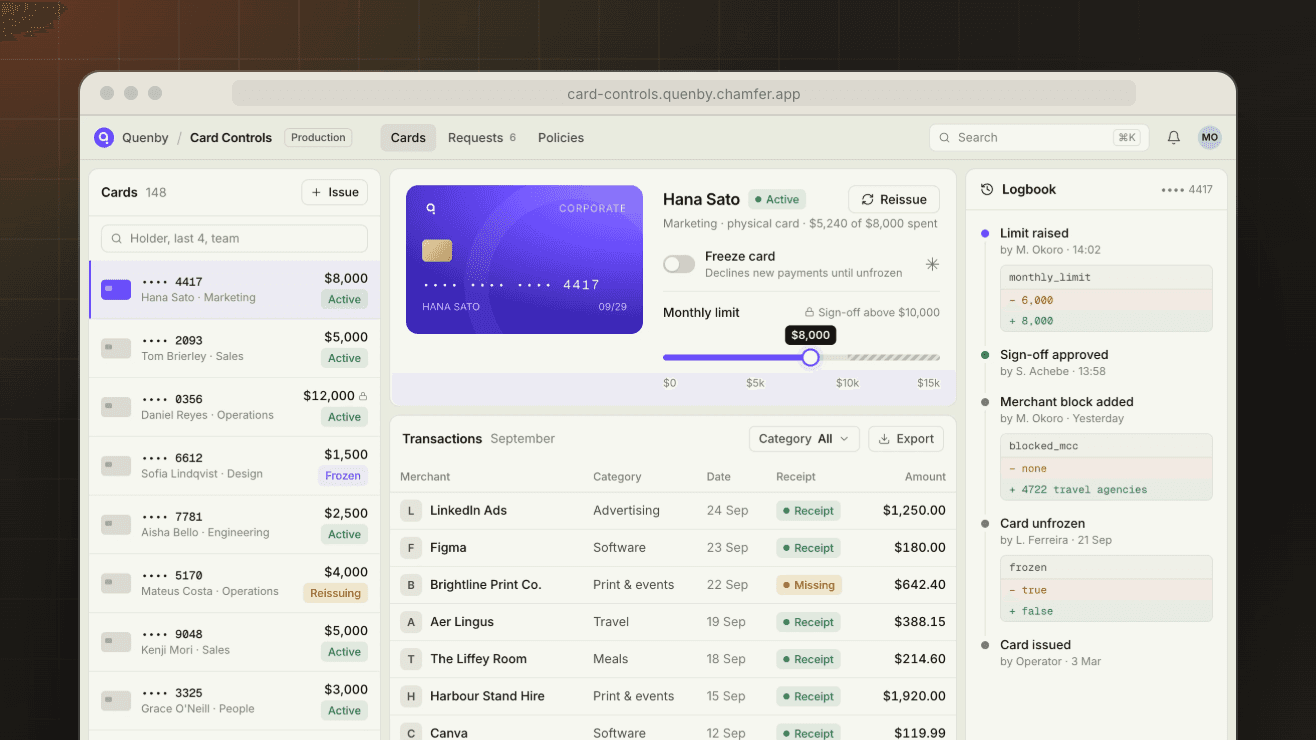
Then they handed the Bench to the teams who had been filing tickets. Finance built Card Controls in an afternoon: search a card, freeze it, change its limit or reissue it. Customer success built a Renewals Board that shows every contract due in the next 90 days, with account health from Salesforce and an owner on each card. Risk built a card freeze screen of its own the following week.
Engineers still review what ships. Every release goes through a Sign-off with a diff, and each app’s source syncs to a GitHub repository, so code review happens where engineers already work.
Controls a regulator can read
Quenby’s payments regulator audits it every year. The Logbook gives the auditors a single export with every limit change, who approved it and when. Access follows Okta groups, so a contractor’s access ends on the day their contract does. The security team runs a monthly access review in a Chamfer app, and the results go straight into the audit file.
“The first audit after the switch took two days instead of two weeks,” Theo says. “Every question had a row in the Logbook.”
What changed
1,900 engineering hours returned in the first year
17 admin tools moved off the engineering backlog
Admin changes shipped in 2 days on average, down from 3 weeks
Eight people across finance, risk and customer success now build on Chamfer. Engineering reviews their releases, owns the Specs and spends the rest of its time on the card platform.
“Engineering stopped owning admin panels. We review the Specs, approve the permissions and get back to the product.”

Theo Marchetti
VP Engineering, Quenby
Read another story

How Kettleby Freight retired 14 spreadsheets in a quarter

Kettleby's finance operations team replaced 14 spreadsheet processes with Chamfer apps, each with a named approver before launch.
Read the story →

Halden Mutual cut claims triage from 3 days to 4 hours

Halden's claims team scores and routes every new claim within hours, and IT Risk answers its auditors straight from the Logbook.
Read the story →

Tessaly put 40 agents on a new refund queue in 4 days

Tessaly's support team described a refund queue on Monday and had 40 agents working it behind SSO by Thursday.
Read the story →