
How Saltmarsh & Co. cut food waste 18% across 42 stores
18%
less food waste across 42 stores
$1.4M
less stock written off in year one
2 hrs
earlier markdown decisions each day
At a glance
Industry
Retail & marketplaces
Company size
4,700 people
Headquarters
Portland, ME
Team
Operations
Builders and members
4 builders, 210 members
Apps built
8 apps
Built with


The company
Saltmarsh & Co. is a family-owned grocery chain with 42 stores across Maine, New Hampshire and Vermont. Its 4,700 people run fresh counters, in-store bakeries and a same-day delivery service.
Markdowns at six o’clock
Every Saltmarsh store marks down fresh food before closing. Until 2025, the store manager walked the aisles with a price gun and decided on the spot. Some stores cut prices too early and gave away margin. Others cut too late and threw the food away. Head office saw the result a month later in the waste report. Waste ran at 4.1% of fresh sales, and nobody could say which stores were doing well.
Nora Whitcombe, Director of Store Operations, wanted the decision made earlier and made the same way in every store. The data already existed: sales and waste by item in Databricks, and same-day delivery orders from the online store on Shopify.
A priced batch, approved in the aisle
The operations team described the tool on the Bench in one prompt: read today’s stock and sell-through for each store, suggest a markdown for anything unlikely to sell, and ask the store manager to approve the batch.
The first version priced every item the same way. Store managers asked for exceptions within a day: never mark down baby formula, hold the bakery until 5 p.m., round prices to end in 9. The team added each one as a plain-English rule and had the change live the same afternoon. The data team had already checked the pricing logic against six months of sales, and every change to it goes through a Sign-off.
Markdown Manager went to 6 pilot stores in April and to all 42 by June. A manager opens it at 4 p.m., checks the suggested batch, adjusts anything that looks wrong and presses Approve. The new prices go to the shelf-edge labels, and a summary posts to the store’s Slack channel.
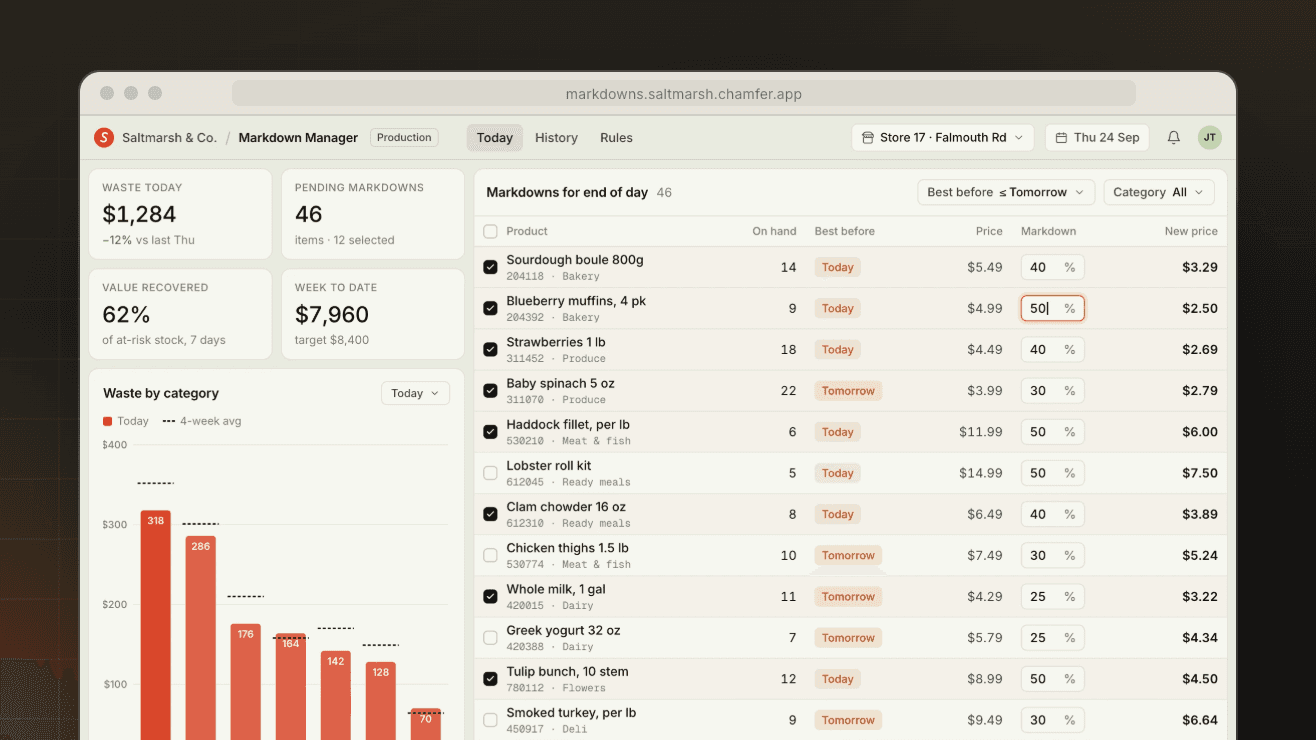
Each store sees its own shelves
Store managers see only their own store. District managers see their stores and can compare waste by category. Head office sees everything but can’t approve a batch on a store’s behalf, so the decision stays with the person standing in the aisle. Store managers can’t change the pricing rules, only the batch in front of them. Every approval, change and override is in the Logbook.
“We finally know which stores mark down well and why,” Nora says. “The good habits spread in weeks instead of years.”
What changed
Food waste down 18% across 42 stores
$1.4 million less stock written off in the first year
Markdown decisions made 2 hours earlier on average
The team has since built a delivery-slot planner and a supplier credit tracker, and both follow the same store-by-store access rule.
“Store managers used to guess at markdowns at six o'clock. Now they approve a batch that's already priced, and we can see every decision.”
Nora Whitcombe
Director of Store Operations, Saltmarsh & Co.
Read another story

How Kettleby Freight retired 14 spreadsheets in a quarter

Kettleby's finance operations team replaced 14 spreadsheet processes with Chamfer apps, each with a named approver before launch.
Read the story →

Halden Mutual cut claims triage from 3 days to 4 hours

Halden's claims team scores and routes every new claim within hours, and IT Risk answers its auditors straight from the Logbook.
Read the story →

Tessaly put 40 agents on a new refund queue in 4 days

Tessaly's support team described a refund queue on Monday and had 40 agents working it behind SSO by Thursday.
Read the story →